
Case Study · Water Systems
Treat each runoff at its source.
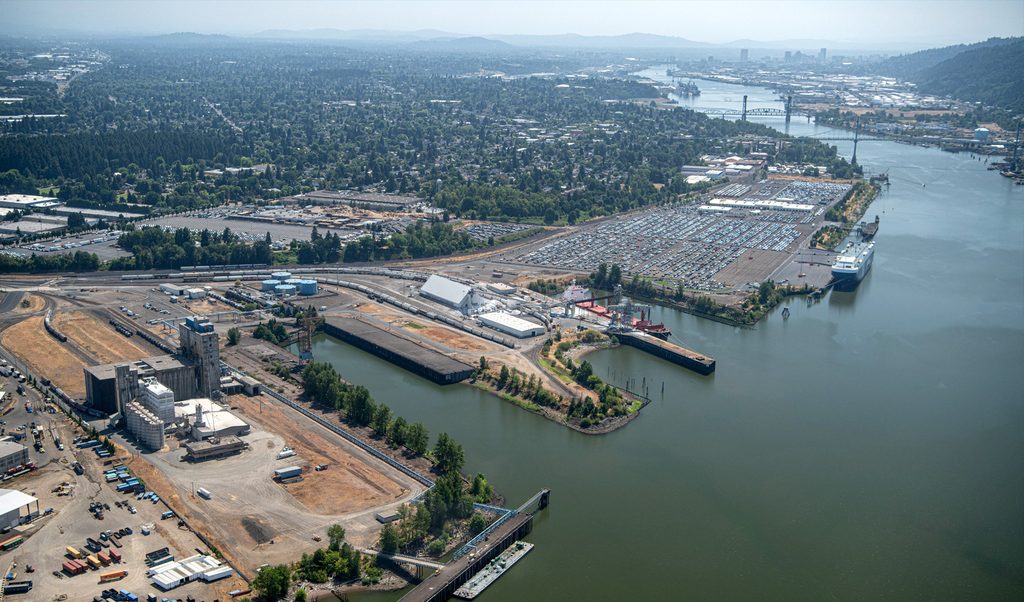
Terminal 4 sits on the Willamette River in Portland, Oregon. Truck loading, new vehicle storage, and bulk rail cargo each produce a different kind of runoff, so each area has its own treatment system to clean the water before it reaches the river.
-
Client
-
Port of Portland
-
Facility
-
Terminal 4
-
Practice
-
Water Systems
-
Approach
-
Structural + natural hybrid
The Short Version
Project Summary
Terminal 4 puts acres of pavement beside a salmon-bearing river, and the runoff varies across the site. Trucks leave oil and hydraulic fluid on the loading area. The vehicle storage lot sits downhill from a busy road and a rail line, so their runoff crosses it. In the rail yard, soda ash and potash leave dust fine enough to pass through most treatment systems.
Each problem got its own answer. In the truck loading area, water passes through three steps in series: catch basin inserts, oil-water separators with coalescing plates, and a vegetated bioswale. The vehicle storage lot uses hydrodynamic separators. The rail yard uses a vault of cartridge filters that capture particles as small as 15 microns.
KEY STATS
- 3 treatment areas, each matched to its runoff
- 3 treatment steps in series at the truck loading area
- 99% of oil droplets 60 microns and larger removed by the separators (manufacturer-reported)
- 10+ filter cartridges in the rail yard vault
- 15 microns, the smallest particle the filter vault captures
The full story
Project Overview
Background
Terminal 4 is one of the Port of Portland’s marine terminals on the Willamette River. Toyota Logistics Services uses it to receive, process, and ship new vehicles, with a First Point of Rest for vehicles coming off the ship, a processing facility, a holding area, and rail and truck loading. A Kinder Morgan bulk terminal at T4 ships soda ash and potash by rail.
A site this size produces high runoff volume and velocity, and the runoff can pick up large amounts of sediment and pollutants. As part of a citywide effort to go beyond baseline requirements, the Port and its tenants set out to treat the runoff from every area before it reached the river. Toyota installed most of the systems on its leasehold, and the Port installed the system serving the rail yard.
Truck Loading Area: Three Steps in Series
Trucks bring oil and hydraulic fluid onto the pavement, which makes this the most polluted runoff on the site.
The first step is at the curb inlets. In the northwest corner, where little oil reaches the inlets, fabric “witch hat” inserts catch sediment and hold up to about 1.4 gallons of hydrocarbons. Beside the loading lanes, where spills are frequent, stainless steel inserts with oil filters (FloGard+Plus) are used. The manufacturer reports removal of about 70 percent of oil and grease, 80 percent of total suspended solids, and 40 percent of total phosphorus.
Depending on conditions, these inserts need service anywhere from once a month to twice a year.
Next, the water enters oil-water separators fitted with coalescing plates (VortClarex). The plates gather small oil droplets so they join together and rise faster. The manufacturer reports 99 percent removal of droplets 60 microns and larger, compared with about 150 microns for a standard gravity separator.
Last, the water flows through a bioswale planted with native grasses, shrubs, and trees. The swale slows and cools the water and removes pollutants the first two steps missed. It also stabilizes the riverbank and keeps warm water out of the river, which supported the site’s Salmon-Safe certification.
First Point of Rest: Runoff from Next Door
The First Point of Rest is a paved lot that holds thousands of new vehicles after they come off the ship. New vehicles rarely leak, but the lot sits downhill from a road with heavy truck traffic and a main rail line, and runoff from both crosses it.
Toyota installed three hydrodynamic separators (Downstream Defender) to treat it. Each unit spins incoming water so sediment settles to the bottom and oil and grease are held back. Depending on size, a unit handles peak flows of 3 to 25 cubic feet per second.
Rail Yard: Filtering Fine Dust
Kinder Morgan’s bulk terminal ships soda ash and potash on the Union Pacific Railroad. Dust from these cargoes is fine enough to pass through most treatment systems, which capture particles of about 50 to 100 microns and larger.
The Port installed a vault holding more than 10 StormFilter cartridges (Contech). Each cartridge is filled with media chosen for the target pollutant, and the system captures particles as small as 15 microns.
The Results
Runoff from every area of Terminal 4 is now treated before it reaches the Willamette, using the system suited to its pollutant: a three-step treatment train where trucks operate, separators where outside runoff crosses the vehicle lot, and fine filtration where bulk cargo dust is the concern. Putting each system where its pollutant starts kept costs in proportion to the problem, and the same approach applies to any terminal where different operations share one site.
Natural storm water systems do treatment work and aesthetic work at the same time. The limit is space, and terminals that master-plan for green buffers early rarely regret it.
TDG Water Practice, natural systems overview
Partner With Us
Working with a waterfront terminal?
Tell us about your site and we will share the storm water zoning logic and references that apply.